
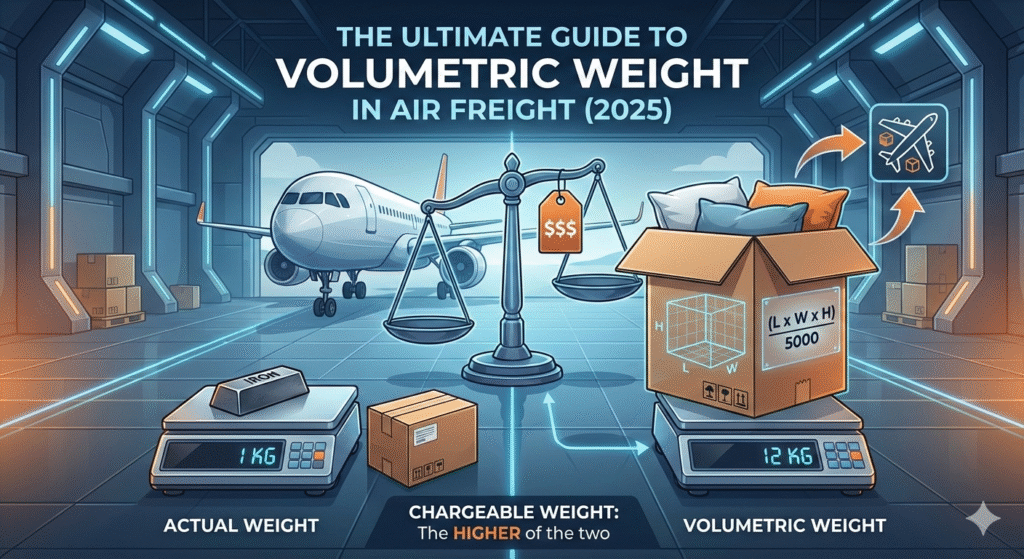
Have you ever shipped a package that was light as a feather but large in size, only to be shocked by an incredibly high shipping invoice? You likely fell victim to Volumetric Weight.
Whether you are an Amazon FBA seller, an importer, or just sending a gift overseas, understanding the difference between “Actual Weight” and “Volumetric Weight” is the #1 way to save money on shipping costs.
In this guide, we will break down the volumetric weight formula, why couriers use it, and how you can calculate it instantly to avoid surprise fees.
What is Volumetric Weight?
Volumetric weight (also called Dimensional Weight or Dim Weight) is a pricing technique used by courier companies (like DHL, FedEx, UPS) and air freight forwarders.
Couriers charge you based on density, not just dead weight. Imagine a plane cargo hold. Space is limited.
- Scenario A: A 1kg iron bar is small. It takes up very little space.
- Scenario B: A 1kg box of pillows is huge. It takes up a lot of space.
If the airline charged only by weight, they would lose money on the pillows because that one box fills up space that could hold 50kg of iron. To solve this, they charge based on the volume the package occupies.
The Volumetric Weight Formula (2025 Standard)
The industry standard formula for calculating volumetric weight depends on whether you are using a Courier (Express) or a traditional Air Freight Forwarder.
1. The Standard Courier Formula (DHL, FedEx, UPS)
Most express couriers use a divisor of 5000.
Formula: (Length x Width x Height in cm) / 5000 = Volumetric Weight (kg)
Example: You have a box measuring 50cm x 40cm x 30cm. The actual weight on the scale is 5kg.
- Calculate Volume: 50 * 40 * 30 = 60,000 cubic cm.
- Divide by 5000: 60,000 https://www.google.com/search?q=/ 5000 = 12 kg.
Result: Even though the box weighs 5kg, you will be billed for 12kg. This is the “Chargeable Weight.”
2. The Air Freight Formula (Forwarders)
Some cheaper air freight consolidators use a divisor of 6000, which is more favorable to the shipper.
Formula: (Length x Width x Height in cm) / 6000 = Volumetric Weight (kg)
Always ask your freight forwarder: “Is your divisor 5000 or 6000?” This single question can save you 20% on shipping.
Chargeable Weight: The Golden Rule
Shipping companies will always look at two numbers:
- Gross Weight: The actual weight on the scale.
- Volumetric Weight: The calculated size weight.
They will always charge the HIGHER of the two.
Pro Tip for Amazon FBA Sellers
If you are sourcing products from Alibaba, try to minimize the “empty air” in your product packaging. If your product is small but the box is big, you are paying to ship air. Reducing your box size by just 2cm can sometimes save hundreds of dollars on a bulk shipment.
Conclusion
Understanding the volumetric weight formula is crucial for accurate shipping budgets. Never assume the “dead weight” is what you will pay. Always measure your boxes, use the divisor of 5000 (to be safe), and compare it to the actual weight.
Ready to calculate your shipment? Use our CBM Calculator now to get an instant estimate.
Pingback: Pallet Loading Guide: How Many Standard Pallets Fit in a Container? - thecbmcalc.com