
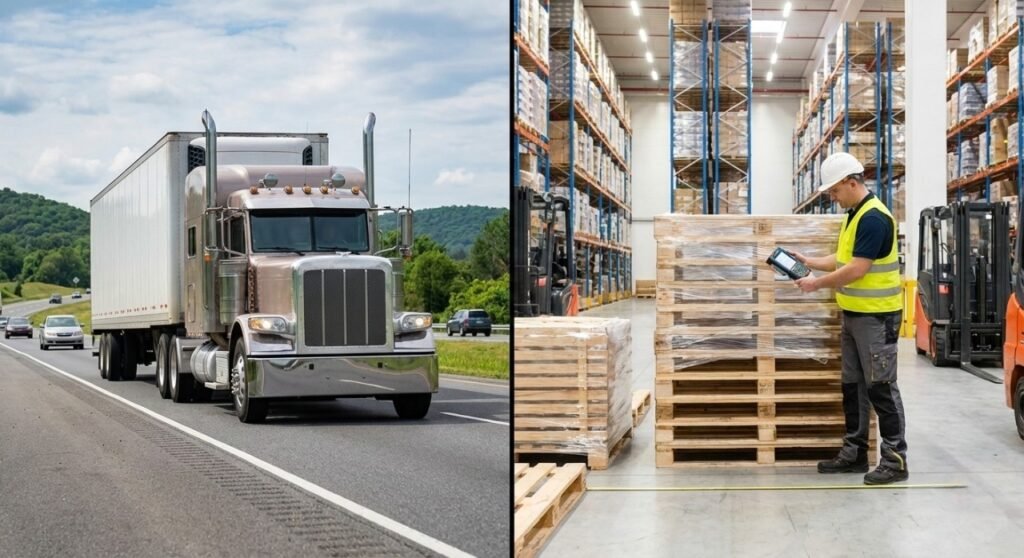
Once your shipment arrives at a US port (like Los Angeles or New York), it usually needs to travel by truck to an Amazon FBA warehouse or your door. This is where LTL (Less Than Truckload) shipping comes in.
Unlike sea freight, US trucking does not just charge by volume. They charge by Freight Class. If you declare the wrong class, the carrier will re-classify your shipment and charge you a hefty “Re-weigh & Inspection Fee.”
What is Freight Class?
The NMFC (National Motor Freight Classification) system groups goods into 18 classes, ranging from Class 50 (Cheapest) to Class 500 (Most Expensive).
The class is determined by four factors:
- Density: (Weight per cubic foot).
- Stowability: (Is it easy to stack?).
- Handling: (Is it fragile?).
- Liability: (Is it high valueh / theft risk?).
Density is the #1 Factor
For most standard goods (boxes on pallets), Density determines the class.
- High Density (Heavy/Compact): Lower Class = Lower Price. (e.g., Bricks, Steel, Books).
- Low Density (Light/Bulky): Higher Class = Higher Price. (e.g., Ping Pong balls, Foam mattresses).
The Density Formula
Trucking companies calculate density in Pounds per Cubic Foot (PCF).
Formula: Weight (lbs) / Volume (cubic feet) = Density (PCF)
Example:
- You have a pallet weighing 500 lbs.
- The volume of the pallet is 50 cubic feet.
- 500 / 50 = 10 PCF.
Cheat Sheet: Common Freight Classes
| Density (PCF) | Freight Class | Typical Items |
| Over 50 | Class 50 | Steel bolts, Nuts, Screws |
| 30 – 35 | Class 60 | Car accessories, Ceramics |
| 15 – 22.5 | Class 85 | Computers, Monitors, Crated Machinery |
| 10.5 – 12 | Class 100 | Boat covers, Wine, Towels |
| 6 – 8 | Class 150 | Furniture, Auto body parts |
| Less than 1 | Class 500 | Ping Pong Balls, Gold dust |
Note: The lower the density, the higher the class, and the more you pay.
How to Avoid Re-Classification Fees
- Don’t Guess: Never guess the weight or dimensions of your pallet. Measure it exactly.
- Include the Pallet: The dimensions must include the wooden pallet itself.
- Use a Calculator: Before booking a truck, calculate your PCF (Pounds per Cubic Foot).
- Write it on the BOL: Clearly state the NMFC code and Class on your Bill of Lading (BOL).
Need to find your Cubic Feet? Use our CBM Calculator on the homepage to get the volume in CBM, then convert to Cubic Feet (multiply by 35.315) to calculate your density.